Blurred Vision
I picked up my "older" camera to look at the photos that are on its SD card and familiarize myself with it once more. I didn't think at first that I would ever learn enough to use it, but I got braver and slowly gained experience. I was afraid to shoot in manual mode (self-inflicted reaction for sure). The lessons in fear proved to be a waste of time. I really just needed to start. Over years and thousands of photos later, I had enough print worthy images to write about in my book, "What Do You Spy with Your Eagle Eyes?"
Fast forward to now: I recently had the "not being present lesson" happen in spades. Because I was doing too many things at once, my newer camera is in need of inspection and likely repair. Moving too fast, not thinking or taking time to attach the camera to the tether on my harness (a fatal flaw), it came loose from the harness as I stepped out of the car, my hands full of other things. There was no parachute or safety net. Just a solid drop to the blacktop, led by the heavy lens attached to the camera body.
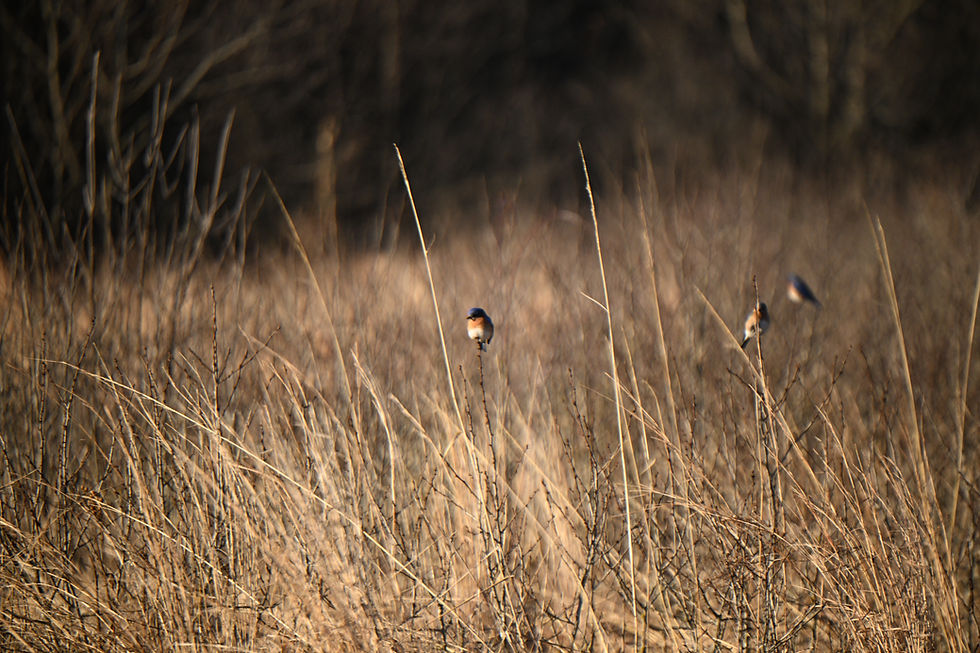
I was devastated that I could be so careless. It was an immediate and consequential lesson. A good friend told me, "The thing about mistakes and accidents -- we still do them; they just get more expensive the older we get." I'd add that the monetary cost was only a part of it, when I looked at the time I spent testing and dealing with uncertainty - was it me or was the camera producing less than tack-sharp images? Was it the lens? The camera body? All of it? I spent time ruling things out. And when did that clicking noise happen? The camera fooled me sometimes, but finer details were not quite right. With bird photos, the eye really needs to be crisply in focus. The bluebirds perched on stalks of last year's plants should have been tack-sharp but instead they have a blurred look that I didn't expect.

I was embarrassed. I took even more time, hesitating to own up to what I did, hoping it would all go away like a bad dream. But what is always necessary is to cut to the chase: truthfully explain what happened and get the repair going.
With my camera safely stowed in my car, I drove to West Photo in Minneapolis. The person at the camera store was kind, asking me how many cameras I've dropped, and smiled a bit. I responded with a firm (and dramatic) shake of my head, "Never; until now." He said, "It will be your last time. Don't be so hard on yourself; it happens to everyone once." There was that drama pattern of mine again. I was grateful for that comment. With a sense of relief, off my camera went to be repaired.
Instead of worrying further, I choose to believe my camera will return in "like new" condition. I'm grateful that I have this camera in the first place and to even have an "older"(and perfectly good) camera. It does just fine in many cases, thanks very much. On its SD card, I found a number of fine shots, like this pair of egrets captured when the light was just right.

I'm also grateful that
I have a camera that I'm still learning on and will use more.
there are kind people in the world who don't judge others (me).
I saw that I hesitated to take the camera in for repair instead of taking action sooner.
I saw an old behavior pattern that I can stop so I can be more decisive and compassionate towards myself.
I know there are endless lessons as opportunities to help me grow. Something will appear for me to clear my blurred vision so I can pause, reflect, breathe and practice.
I can focus on that.


Comments